

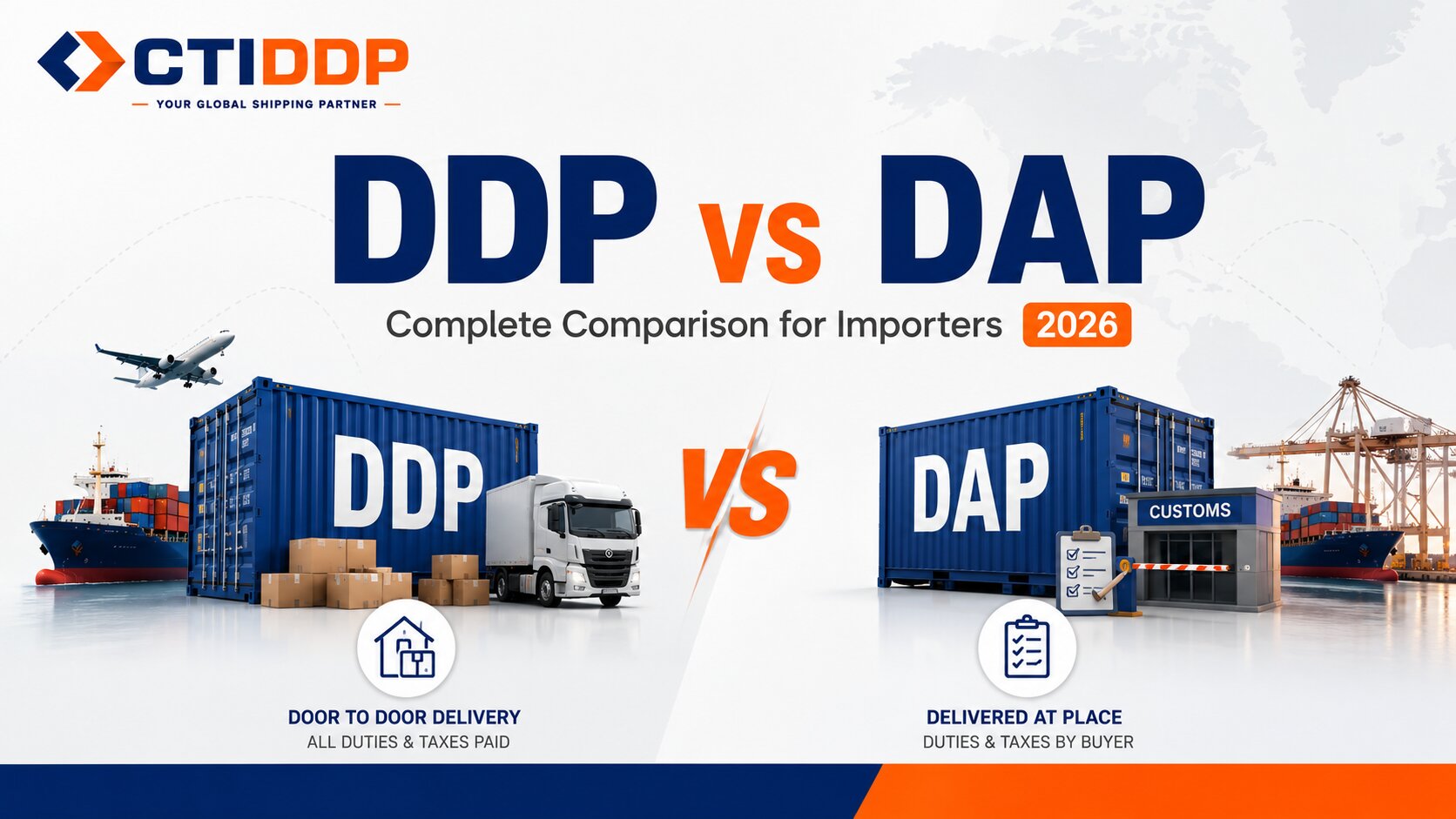
When importing from China to India, choosing the right Incoterm can significantly impact your total landed cost, risk exposure, and operational workload. Two of the most commonly discussed terms in 2026 are DDP (Delivered Duty Paid) and DAP (Delivered at Place).
Many Indian importers still get confused between these two, often leading to unexpected costs at customs or disputes with Chinese suppliers. Having facilitated hundreds of shipments from China to India, we’ve seen how the choice between DDP and DAP affects everything from cash flow to clearance speed.
This guide provides a practical, real-world comparison to help you make an informed decision.
Understanding DDP and DAP in Simple Terms
DDP (Delivered Duty Paid) means the seller (or their logistics partner) is responsible for delivering the goods to the agreed destination in India, having cleared all import customs formalities and paid all duties and taxes.
DAP (Delivered at Place) means the seller delivers the goods to the named place (usually your warehouse or port in India), but the buyer is responsible for import customs clearance and payment of duties.
The core difference lies in who handles customs clearance and pays the duties.
Detailed Side-by-Side Comparison: DDP vs DAP
Here’s a clear comparison most Indian importers need to understand:
Aspect | DDP (Delivered Duty Paid) | DAP (Delivered at Place) |
|---|---|---|
Seller’s Responsibility | Up to delivery + customs clearance + duty payment | Up to delivery at named place |
Buyer’s Responsibility | Minimal (just unloading & local transport) | Import clearance + duty payment |
Risk Transfer | At buyer’s premises | When goods are ready for unloading at destination |
Customs Clearance | Handled by seller | Handled by buyer |
Duty & Tax Payment | Paid by seller | Paid by buyer |
Documentation Load | Mostly on seller | Mostly on buyer |
Cost Predictability | High | Medium |
Key Takeaway: DDP shifts most of the import complexity to the seller, while DAP keeps customs responsibility with the Indian importer.
Cost Implications – DDP vs DAP
Many importers assume DAP is cheaper because they pay duties directly. However, the reality in 2026 is more nuanced.
Hidden Costs in DAP:
Customs broker fees
Demurrage & detention charges due to delays in filing
Higher working capital blocked in duties
Penalty risks due to classification errors
Advantage of DDP:
Experienced DDP partners often secure better freight rates and faster clearance, which can offset the margin they charge.
Risk and Responsibility Transfer – A Critical Difference
One of the most important distinctions between DDP vs DAP lies in when risk transfers from the seller to the buyer.
In DAP, risk transfers to the buyer once the goods reach the named place (e.g., your warehouse or port in India), even before customs clearance.
In DDP, risk remains with the seller until the goods are delivered and cleared at your premises.
Real-World Implication for Indian Importers:
During monsoon season or peak port congestion periods, DAP shipments often face higher risk of damage or delays while waiting for clearance. With DDP, the logistics partner continues to bear responsibility until final delivery.
Customs Clearance & Compliance Considerations in India
Under DAP:
You (the Indian importer) are fully responsible for:
Filing the Bill of Entry
HS code classification
Payment of BCD, IGST, and SWS
Handling any customs queries or examinations
This gives you more control but also exposes you to compliance risks, especially if your team is not well-versed with frequent changes in Indian customs regulations.
Under DDP:
Your logistics partner handles the entire customs process. This is particularly beneficial for businesses that:
Import occasionally
Lack an in-house customs expert
Want to avoid blocked working capital in duties
However, you must ensure your DDP partner is experienced with Indian customs procedures and maintains full transparency in duty calculation.
When Should You Choose DDP vs DAP?
Choose DDP if:
You want predictable total landed cost
You prefer minimal involvement in customs procedures
You are importing high-value or regulated goods
You are new to importing or have limited staff
You value speed and convenience over slight cost savings
Choose DAP if:
You have a strong in-house logistics or compliance team
You want maximum control over customs valuation
You import in very high volumes and can negotiate better freight rates
You have established relationships with reliable customs brokers
Our Experience at CTIDDP:
Over 70% of our Indian clients in 2026 prefer DDP for its simplicity, especially when importing machinery, electronics, and multi-vendor consolidated shipments.
Operational Impact on Your Supply Chain
Cash Flow:
DAP requires you to pay duties upfront or at clearance, blocking capital. DDP allows better cash flow planning since duties are included in the quoted price.
Time Efficiency:
DDP shipments generally clear faster because professional forwarders handle documentation daily and maintain strong relationships with customs officials.
Scalability:
As your import volume grows, DDP allows you to focus on sales and product development instead of logistics management.
Pros and Cons Summary – DDP vs DAP
DDP – Pros:
Single point of accountability
Better cost predictability
Reduced administrative burden
Faster overall transit time in many cases
Lower risk of customs penalties
DDP – Cons:
Slightly higher quoted price (due to partner margin)
Less visibility/control over customs valuation
Dependency on the DDP provider’s expertise
DAP – Pros:
Potentially lower overall cost if managed well
Greater control over the clearance process
More flexibility in choosing your own customs broker
DAP – Cons:
Higher operational workload
Increased risk of delays and unexpected costs
Working capital tied up in duties
Higher chance of compliance issues
Real-World Scenarios from Indian Importers
Case 1: Machinery Importer in Coimbatore
Switched from DAP to DDP after facing repeated customs examination delays. Result: 12-day faster delivery and 9% lower total cost due to better routing.
Case 2: Electronics Importer in Delhi
Stuck with DAP for high-volume shipments. They built an internal team and saved approximately 6–7% compared to DDP quotes.
Case 3: New Importer in Surat (Textiles)
Chose DDP for first 8 shipments. This allowed them to focus on market expansion instead of learning customs procedures.
Best Practices When Choosing Between DDP and DAP
Always ask for landed cost quotes under both terms for comparison.
Evaluate your internal team’s capacity to handle customs.
Check your partner’s experience with Indian ports (Nhava Sheva, Chennai, Mundra, etc.).
Ensure clear agreement on delivery point and what’s included.
Start with DDP if you are importing new products or working with new suppliers.
Conclusion
In 2026, there is no universal “better” choice between DDP vs DAP. The right decision depends on your business size, import volume, internal capabilities, and risk appetite.
For most small and medium Indian importers sourcing from China, DDP offers significant advantages in simplicity, predictability, and peace of mind. Larger, more experienced importers with strong logistics teams may benefit from DAP in high-volume, consistent shipments.
The key is understanding your operational reality and working with a transparent, experienced partner who can support either term effectively.
Ready to Choose the Right Shipping Term for Your Next China Import?
At CTIDDP, we provide transparent quotes for DDP, along with expert advice on which option suits your specific shipment better.
Get a side-by-side landed cost comparison within 2 hours.
Contact us today:
Email: info@ctiddp.com
Website: www.ctiddp.com
Let our team help you make the smartest import decision for your business.
Suggested External Links:
FAQ Section:
Q1: What is the main difference between DDP and DAP?
In DDP, the seller handles customs clearance and pays all import duties in India. In DAP, the seller delivers goods to the destination, but the buyer is responsible for customs clearance and duty payment.
Q2: Which is better for Indian importers – DDP or DAP?
For most small and medium businesses, DDP is better due to simplicity and predictability. Experienced large importers with strong logistics teams may prefer DAP to save costs.
Q3: Does DDP cost more than DAP?
DDP usually has a higher quoted price because it includes duties and clearance. However, total landed cost can sometimes be lower with DDP due to faster clearance and fewer hidden fees.
Q4: Who pays the customs duty in DDP vs DAP?
In DDP, the seller (or their partner) pays BCD + IGST. In DAP, the Indian importer pays all duties directly.
Q5: When should I choose DAP over DDP?
Choose DAP if you have an experienced internal team, import very high volumes, and want full control over customs valuation and clearance.
Q6: Is risk higher in DDP or DAP?
Risk is generally higher in DAP because responsibility transfers to the buyer earlier, especially during customs clearance.
Q7: Can I switch from DAP to DDP later?
Yes, but it’s better to decide before placing the order. Working with a flexible DDP partner makes switching easier.
Q8: Does CTIDDP offer both DDP and DAP services?
Yes. We provide transparent quotes and expert recommendations for both DDP and DAP based on your shipment type, volume, and business needs.