
Air Freight vs. Sea Freight from China to India: Cost, Transit Time & Best Use Cases (2026)
Choosing between air freight and sea freight from China to India is not simply a decision between speed and cost. It directly affects your inventory availability, working capital, production schedules, profit margins, and ability to fulfil customer orders.
Air freight is generally suitable for urgent, lightweight, high-value, and time-sensitive shipments. Sea freight is typically more economical for heavy machinery, bulky products, commercial inventory, and large-volume imports.
However, choosing the cheapest transportation method does not always result in the lowest overall business cost.
An Indian manufacturer waiting for a critical machine component may lose more money through production downtime than it would spend on air freight. Similarly, a furniture distributor shipping bulky inventory by air could significantly reduce its profit margins through unnecessary freight expenditure.
This guide explains how Indian businesses can make better freight decisions using landed cost calculations, cargo characteristics, transit times, customs compliance, and operational risk assessments.
1. Air Freight vs. Sea Freight: Quick Comparison
Air freight transports commercial cargo using aircraft, while sea freight moves goods through international shipping vessels and containers.
Both methods support international trade between China and India, but their suitability depends on shipment dimensions, product value, delivery urgency, and overall logistics requirements.
Comparison Factor | Air Freight | Sea Freight |
Transportation speed | Fast | Relatively slow |
Indicative door-to-door time | 5–10 days | 20–40 days |
Shipping cost | Generally higher | Generally lower for bulk cargo |
Pricing method | Chargeable weight (kg) | CBM, weight or container |
Cargo capacity | Limited by aircraft | High |
Best suited for | Urgent, compact, high-value goods | Heavy, bulky and commercial cargo |
Inventory planning | Shorter replenishment cycles | Longer replenishment cycles |
Environmental impact | Generally higher emissions | Generally lower emissions per tonne-km |
Shipment frequency | Depends on flight availability | Depends on vessel schedules |
Common products | Electronics, samples, spare parts | Machinery, furniture, bulk inventory |
Transit times are indicative planning estimates, not guaranteed delivery schedules or live carrier quotations.
The most effective approach is to evaluate total business costs rather than freight charges alone.
2. What Is Air Freight from China to India?
Air freight involves transporting goods through dedicated cargo aircraft or available cargo capacity on commercial passenger flights.
It is particularly useful when Indian businesses need faster inventory replenishment, production-critical components, product samples, or urgent commercial shipments.
How does air freight work?
A typical air freight shipment involves the following operational stages:
Supplier pickup in China
Warehouse receiving and cargo inspection
Weight and dimensional verification
Export customs clearance and security screening
International air transportation
Import customs clearance in India
Last-mile delivery to the consignee
Although the actual flight may take only several hours, the complete shipment requires additional time for documentation, cargo handling, customs assessment, and domestic delivery.
When should importers choose air freight?
Air freight is generally suitable for:
Industrial spare parts needed for urgent repairs.
Compact electronic components and electrical equipment.
Product samples for supplier evaluation.
High-value, low-volume commercial shipments.
Emergency inventory replenishment.
Small automotive and machinery components.
Products required for exhibitions or business launches.
Limitations of air freight
Air freight becomes expensive when cargo occupies significant aircraft space, even if its physical weight is low.
Oversized industrial machinery may also exceed aircraft loading dimensions. Products containing lithium batteries, magnets, or other regulated components may require additional screening, documentation, and carrier approval.
Importers should confirm cargo acceptance before paying suppliers or booking transportation.
3. What Is Sea Freight from China to India?
Sea freight, also known as ocean freight, involves transporting commercial goods through international shipping vessels.
It is widely used for scheduled inventory replenishment, industrial equipment, furniture, agricultural machinery, and large commercial consignments.
FCL — Full Container Load
FCL involves booking an entire shipping container for a consignment.
Common container options include 20-foot, 40-foot, and 40-foot high-cube containers.
FCL is particularly useful when businesses have sufficient cargo volume, require fewer cargo-handling stages, or need greater control over container loading and security.
An importer does not necessarily need to fill every available cubic metre to justify FCL. Sometimes the overall FCL quotation becomes more economical than LCL before reaching full container capacity.
LCL — Less than Container Load
LCL allows multiple importers to share space within a shipping container.
Businesses generally pay based on the shipment's chargeable volume or weight rather than booking an entire container.
Factor | FCL Shipping | LCL Shipping |
Container usage | Dedicated container | Shared container |
Suitable cargo | Large consignments | Small to medium consignments |
Pricing | Per container | Weight or measurement |
Cargo handling | Generally fewer stages | Additional consolidation stages |
Transit predictability | Generally better | Affected by consolidation |
Typical application | Bulk commercial imports | MSMEs and smaller importers |
LCL can be particularly useful for Indian MSMEs purchasing goods from multiple Chinese suppliers. However, consolidation, deconsolidation, and destination handling charges must be included in the cost comparison.
4. Air Freight vs. Sea Freight Cost from China to India
Shipping costs vary depending on the origin city, destination, cargo dimensions, shipment date, carrier capacity, product category, and agreed delivery terms.
There is no universal China-to-India freight rate applicable to every shipment.
How are air freight charges calculated?
Air cargo pricing generally uses chargeable weight, which is the higher of actual gross weight and volumetric weight.
A commonly used international air cargo volumetric formula is:
Volumetric Weight (kg)= L×W×H / 6000
All dimensions must be measured in centimeters. The applicable divisor and rounding rules should be confirmed with the freight provider.
How are sea freight charges calculated?
Sea freight pricing generally depends on container type, or cargo weight and volume for LCL.
CBM = L×W×H / 1000000
Many LCL services use a weight-or-measurement pricing model, commonly comparing one cubic metre against one metric tonne, subject to the carrier's applicable tariff.
5. Shipping Transit Time from China to India
Importers must understand the difference between carrier transit time and complete door-to-door transit time.
A vessel's sailing duration or an aircraft's flight duration represents only one stage of the logistics process.
Major shipping routes
Common Chinese departure locations include Shanghai, Shenzhen, Guangzhou, Ningbo, Qingdao, and Hong Kong.
Indian cargo destinations include Mumbai, Chennai, Mundra, Delhi, Bengaluru, Hyderabad, and Visakhapatnam, depending on transportation mode and service availability.
Indicative transit time comparison
Shipping Stage | Air Freight | Sea Freight |
Supplier pickup | 1–2 days | 1–3 days |
Origin handling and export clearance | 1–2 days | 2–5 days |
International transportation | 1–3 days | 12–25 days |
Indian customs clearance | 1–3 days | 2–5 days |
Last-mile delivery | 1–3 days | 1–5 days |
Typical planning window | 5–10 days | 20–40 days |
These are approximate planning ranges. Stages may overlap, while transshipment, consolidation, inspections, and cargo restrictions can extend delivery beyond these estimates.
Factors affecting shipping timelines
Chinese New Year, Golden Week, vessel capacity constraints, Indian monsoon conditions, port congestion, customs inspections, and documentation discrepancies can disrupt scheduled deliveries.
Businesses should build contingency time into procurement schedules instead of committing to customers based solely on estimated arrival dates.
6. Which Freight Method Is Best for Different Product Categories?
Different industries have different transportation requirements. A method suitable for electronic components may not be financially practical for industrial machinery.
Product Category | Preferred Mode | Reason |
CNC machines | Sea | Heavy and oversized cargo |
Poultry equipment | Sea | Large commercial volumes |
Electronic components | Air / Sea | Depends on urgency and volume |
Industrial spare parts | Air | Reduces production downtime |
Furniture | Sea | High dimensional volume |
Solar panels | Sea | Bulk capacity and cost efficiency |
Automotive components | Air / Sea | Depends on inventory requirements |
Industrial hardware | Sea | Cost-effective for heavy cargo |
Robotics components | Air / Sea | Depends on size and value |
Product samples | Air | Faster supplier evaluation |
Packaging machinery | Sea | Heavy industrial equipment |
Electrical accessories | Air / Sea | Depends on shipment size |
CTIDDP focuses on eligible commercial and industrial goods. Food products and chemical products are outside CTIDDP's service scope. Other regulated products remain subject to cargo acceptance and applicable compliance requirements.
7. Customs Clearance and Import Compliance in India
Air freight does not eliminate customs requirements, and sea freight does not automatically create higher customs duties.
Both transportation methods require compliance with Indian customs regulations, import policies, product-specific restrictions, and documentation requirements.
Essential import documents
Importers should prepare the following documents and registrations, as applicable:
Importer Exporter Code (IEC).
Commercial invoice and packing list.
Bill of Lading for sea freight or Air Waybill for air freight.
Bill of Entry for Indian customs clearance.
Certificate of Origin, where required.
Insurance documentation.
Applicable product certifications and import authorisations.
Product-specific regulatory compliance
Depending on the product, additional requirements may include BIS certification, WPC approval for wireless equipment, Legal Metrology requirements, or Extended Producer Responsibility obligations.
Importers should verify the applicable Customs Tariff Heading and import policy before confirming supplier orders. The official ICEGATE Compliance Information Portal provides commodity-specific procedures and regulatory information.
Does air freight affect customs duties?
Indian customs valuation can include transportation, insurance, and associated costs in accordance with Section 14 of the Customs Act and the applicable valuation rules.
Consequently, differences in freight expenditure may affect the assessable value, subject to the prescribed valuation provisions. A higher air freight quotation does not necessarily translate directly into an equivalent increase in customs assessable value.
8. Understanding Landed Cost Before Selecting a Freight Method
Many first-time importers compare only the supplier's product price and international freight charges.
Experienced procurement teams instead calculate the total landed cost of bringing goods to their final destination.
A practical landed cost calculation includes:
Product purchase cost
Origin transportation and handling
International freight and insurance
Applicable customs duties and taxes
Clearance and destination handling
Final delivery charges
= Total Landed Cost
Businesses should separately account for eligible recoverable import IGST when calculating net economic cost rather than treating all taxes as permanent expenses.
Practical business scenario
Suppose an Indian manufacturer requires an imported machine component to restart production.
The following example demonstrates why choosing sea freight solely because it is cheaper can be a costly mistake.
Business Factor | Air Freight | Sea Freight |
Logistics cost | ₹87,000 | ₹31,600 |
Delivery time | 7 days | 30 days |
Daily production downtime cost | ₹10,000 | ₹10,000 |
Total downtime cost | ₹70,000 | ₹3,00,000 |
Combined business cost | ₹1,57,000 | ₹3,31,600 |
In this hypothetical scenario, air freight reduces the combined business cost by ₹1,74,600, despite having higher direct logistics charges.
The example assumes production remains stopped throughout transit and that no substitute component is available.
For urgent imports, businesses should calculate the financial impact of delays before selecting the transportation method.
9. Supply Chain Risks and How to Minimise Them
International freight involves operational risks beyond transportation expenses.
Air shipments can experience flight cancellations, cargo offloading, capacity shortages, and security screening delays.
Sea shipments may face vessel rescheduling, port congestion, container shortages, moisture exposure, and additional storage charges.
Risk mitigation strategies
Supply Chain Risk | Recommended Action |
Incorrect cargo dimensions | Verify final packed weight and dimensions |
Customs delays | Review classification and documents before dispatch |
Moisture damage | Use appropriate protective packaging and desiccants |
Supplier quality issues | Arrange pre-shipment quality inspection |
Inventory shortages | Maintain safety stock and emergency replenishment options |
Unexpected charges | Request itemised freight quotations |
Cargo damage or loss | Arrange suitable cargo insurance |
Seasonal disruption | Book ahead and maintain delivery buffers |
For industrial machinery, importers should also confirm lifting requirements, packaging strength, loading arrangements, and unloading responsibilities at the final destination.
10. Hybrid Freight Strategy: Combining Air and Sea Shipping
Businesses do not always need to choose exclusively between air and sea freight.
A hybrid freight strategy uses air freight for urgent requirements while transporting regular commercial inventory through sea freight.
For example, an electronics distributor importing 1,000 units could transport 100 units by air to fulfil immediate customer orders and the remaining 900 units by sea to maintain cost efficiency.
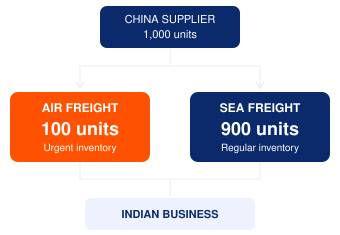
This approach can help importers balance working capital, customer commitments, inventory availability, and transportation expenditure.
It is particularly useful for MSMEs experiencing seasonal demand fluctuations or unpredictable inventory shortages.
11. How DDP Shipping Simplifies China-to-India Imports
Delivered Duty Paid (DDP) is an Incoterms® rule that can be used for both air and sea transportation.
Under DDP, the seller is responsible for arranging delivery and import clearance, including applicable duties and taxes, up to the agreed destination, with goods ready for unloading.
However, a logistics provider's commercial DDP service must not be confused with the legal responsibilities established under an international sales contract.
Businesses should verify the importer-of-record arrangement, customs documentation, tax treatment, and explicit quotation inclusions before accepting any DDP shipping proposal.
How CTIDDP supports Indian importers
CTIDDP helps businesses coordinate China-to-India logistics requirements through services including:
Freight planning and transportation coordination.
Multi-vendor cargo consolidation.
Quality control and pre-shipment inspection.
Customs clearance and duty management.
Warehousing and cargo consolidation.
Last-mile delivery across India.
The objective is to help businesses select a suitable logistics solution based on their cargo requirements rather than recommending the same transportation method for every shipment.
12. How to Choose Between Air Freight and Sea Freight
Before requesting a shipping quotation, evaluate cargo size, inventory urgency, product value, potential downtime costs, and regulatory requirements.
Find the right freight mode
Quick decision-support tool for importersHow urgent is your shipment?
Urgent or production-critical
Regular inventory replenishment
What type of cargo are you importing?
Small, compact shipments
Medium-sized commercial consignments
Heavy machinery or bulky inventory
What is your delivery priority?
Meeting a tight delivery deadline
Reducing overall transportation cost
Suggested starting point
Sea freight (LCL or FCL)
Prioritise volume efficiency and compare complete door-to-door quotations.
Request a freight quotation Indicative guidance, subject to route availability and compliance requirements.
The final decision should always be supported by an itemised quotation and a realistic delivery schedule.
13. Frequently Asked Questions (FAQs)
Is air freight cheaper than sea freight from China to India?
Sea freight is generally cheaper for large and heavy consignments. However, air freight may be competitive for smaller shipments when minimum sea freight charges and destination handling costs are considered.
How long does air freight take from China to India?
Air freight may take approximately 5–10 days for a typical door-to-door shipment, depending on route availability, cargo acceptance, customs clearance, and domestic delivery requirements.
How long does sea freight take from China to India?
Sea freight may take approximately 20–40 days for door-to-door delivery. Transshipment, consolidation, port congestion, and customs inspections can extend this timeline.
Is sea freight better for industrial machinery?
Yes, in most situations. Sea freight generally offers better cargo capacity and transportation cost efficiency for heavy industrial machinery, CNC equipment, furniture, and commercial consignments.
Can I combine shipments from multiple Chinese suppliers?
Yes. Multi-vendor consolidation allows eligible goods purchased from multiple suppliers to be combined into a coordinated shipment, potentially reducing repeated handling and transportation expenses.
Does DDP shipping include customs duties?
Under the DDP Incoterms® rule, applicable import duties and taxes are the seller's responsibility. Importers should confirm the actual contractual arrangements, documentation, and quotation inclusions.
Which freight method is safer?
Neither method is universally safer. Cargo safety depends on packaging quality, handling procedures, product characteristics, carrier practices, and appropriate insurance coverage.
How can I get an accurate shipping quotation?
Provide your product description, supplier pickup location, packing list, gross weight, package dimensions, shipment value, applicable product classification, and final delivery address.
14. Final Verdict: Air Freight or Sea Freight?
The best freight method depends on the business requirements behind the shipment.
Air freight offers faster replenishment and can reduce the cost of stock shortages or production interruptions. Sea freight provides greater capacity and generally lower transportation costs for planned commercial imports.
For Indian MSMEs, manufacturers, and distributors, the most effective shipping strategy combines cost efficiency, reliable delivery planning, customs compliance, and supply chain flexibility.
At CTIDDP, we believe informed importers make better business decisions. Understanding your complete logistics requirements before booking a shipment can help protect profit margins, reduce unexpected expenditure, and build a more resilient supply chain.
Import smarter. Ship with confidence.
Contact CTIDDP to evaluate a suitable China-to-India freight solution for your business.
Website: www.ctiddp.com
CTIDDP — Your Global Shipping Partner.
Suggested External Links
Use authoritative references naturally within the relevant article sections.
Anchor Text | External Link |
|---|---|
Indian Customs Duty Calculator | |
Indian Import Compliance Requirements | |
Customs Valuation Rules | |
Air Cargo Pricing and Tariffs | |
Incoterms® 2020 Rules | |
Foreign Trade Policy and Import Regulations | |
Product Certification Requirements |